
AI Jobseeker & Recruitment Trends 2025
- Dabreo - Content Writer

- Jan 31, 2025
- 7 min read
Updated: Feb 1, 2025

This article looks at the possibilities of replicating the human brain; the capabilities of artificial intelligence; understanding what ChatGPT is and its functionality; what caution is advised when using AI; the new release of ChatGPT’s rival DeepSeek; AI features used in the recruitment process; AI tools for jobseekers; and the future of AI.
Could we replicate the human brain?
It is believed the human brain could be replicated, despite its unique and complex structure. In 2023 a 10-year EU-funded Human Brain Project sought to complete a digital simulation of the human brain, but a major setback was the lack of a theory on how the brain works – it was also questioned if building a simulated brain would be the best way to study it. During the project there were achievements and advancements, such as the development of a highly detailed 3D Brain Atlas and brain models (looking at conditions such as epilepsy) plus a digital platform for brain research called EBRAINS, which today continues to push neuroscience forward. For further reading on the results obtained from the 10-year project released in 2024 visit: Independent expert report: The Human Brain Project significantly advanced neuroscience
What can artificial intelligence not do?
AI cannot (yet!) provide genuine emotion, react instinctively or understand human language. Until technology has reached further advancements, human intervention is still required for many processes and jobs requiring analytical thought.
What type of artificial intelligence is ChatGPT?
ChatGPT is a form of artificial intelligence that aims to replicate a primitive human brain with a focus on deep learning – it is the most advanced type of AI. Advanced processing of unstructured data is used to improve prediction, using neural networks that make sense of data through images, text, or audio. Examples you will be familiar with are Siri, Alexa, self-driving cars, facial recognition software, and voice recognition.
What is ChatGPT?
ChatGPT is based on a large language model called GPT-4 which essentially ingested all the knowledge from the internet up to 2021. It was first launched in November 2022 and amassed a million users in 5 days. The next version is CPT-4 Turbo which has knowledge ingested up to December 2023 and includes enhanced text/images and processing abilities. The ability to chat back and forth with questions understood, and responded to in coherent ways, is the strong appeal. Although ‘trained’ not to provide any negative responses or provide irresponsible information, you can receive harmful and biased information and go around in circles as there is no critical thinking involved. You should also avoid sharing any personal information when engaging with AI to avoid the potential for fraudulent usage.
How do I sign up to use ChatGPT and what can I expect?
You can easily set up an account through ChatGPT Sign-up, where you will discover:
ChatGPT works at speed and can understand human dialogue, answering questions factually.
Your dialogue will sound natural and have memory retention ie. you can receive responses to previous questions asked - most chatbots do not have this function.
The basic version of ChatGTP offers a basic functionality for free, with costs via subscriptions offered for faster responses and access to the more advanced GPT-4 model.
What are the current concerns of ChatGPT?
There are concerns over legal and ethical issues related to copyright, privacy, misuse, and bias. Access is available to anyone, with parental consent requested for those aged 13-18, however, there are no robust age verification systems set in place.
Information about individuals can be inaccurate and cannot, or currently will not, be corrected so there are no GDPR rights for individuals captured by ChatGPT.
There are concerns in the education sector where students use AI platforms to write their essays, but there are also learning opportunities through algorithms which can provide targeted resources. For more information visit ChatGPT For Students
The new ChatGPT – DeepSeek
Launched originally in 2024 from China, DeepSeek became the No. 1 downloaded mobile app in the USA over one January 2025 weekend. The popularity has been due to its matching capability of ChatGPT 01 and being completely free to use. The responses can be slower than ChatGTP but provide more detailed analysis when answering questions, in particular excelling in technical tasks like coding and reasoning. Censoring has been set up by the Chinese government on questions related to human rights violations, government critiques and any responses on topics from a Western perspective which may reflect biases and inaccuracies. For more information visit DeepSeek on LinkedIn
What AI features are currently being used in Recruitment?
Sourcing candidates through AI speed searches, via algorithms which aids machine learning to search job boards and social media platforms. Functions also include interacting with a chatbot in real time providing a faster recruitment process.
Data-driven insights and recommendations can also be gathered through AI-powered tools.
AI Assessments and video interviews, such as HireVue aim to unlock the potential of candidates through virtual interviews and assessments to create a fairer hiring process.
Automated Interview Scoring (AIS), such as Paradox are time saving and provide an interview process without judgement i.e. candidates are not assessed on how they speak or look, preventing any bias at the preliminary stage.
Automated Interview Creator (AIC) platforms will ask the right interview questions based on predicting job performance for particular positions.
Offer and onboarding using AI can create a positive and engaging experience and can enable easy navigation to employees in their first few days on the job.
Predictive analytics are engaged to match candidates based on historical data and assessment of their suitability for a role. However, there is a concern over bias, depending on how the AI analytics are programmed to proceed - this is the defining factor in appropriate selection. To avoid bias the human element has to enter the equation but initial results will be both positive and negative from an EDI perspective.
Future developments will seek to assess a candidate’s interview response such as tone of voice, body language and emotional state – but this will create bias to those candidates whom, for example, are neurodiverse, autistic or have ADHD.
AI Tools for Jobseekers
There are many AI tools available to search for jobs, create CVs and assist with interview preparation. However, AI-generated CVs are easily identified through generic wording/lack of personalisation/buzz words/exaggerated achievements etc. so many companies seek to eliminate applicants through using specialised identification software. All AI-generated content should always be reviewed and edited to ensure it is accurate and original. Using AI as a tool to craft your CV is great, but the CV then requires detailed content analysis to ensure you have included and encapsulated all your relevant skills, experiences and career direction to show you at your best. AI interview generated questions, and mock interviews are also available, which provide helpful preparation, but human analysis and coaching over time is more likely to produce a successful result.
The following platforms provide free/charged services for CV writing, job searching and interview preparation:
ChatGPT-4 (Mainly free with additional charged plans): This is the most suitable model for those looking for CVs tailored to a specific job; generation of interview questions and practice answers; researching and highlighting companies that match your skills/experience.
DeepSeek (Free): Feedback so far online suggests this is a better choice than ChatGPT for delivering more precise/unique results. Read the latest reviews
NodeFlair (Free): Provides job searching for specifically tech roles, career guidance, skills assessments, company reviews, salary comparisons and networking opportunities.
Jobalytics (Free): Analyses job descriptions and highlights keywords missing from your CV – can improve your chances of being noticed by recruiters.
Bard (Currently free but planned charges to be implemented): Provides a deeper dive into industry-specific knowledge on the company you are researching, including emerging trends to help you identify more bespoke interview questions to ask at interview.
Jobscan (Free and charged plans): Analyses your CV, LinkedIn profile against job descriptions identifying areas for improvement.
Kickresume (Free and charged plans): Provides an AI CV writer to tailor your content and keywords.
Teal (Free and charged plans): Provides job searching, produces CVs to specific job applications, job tracker, LinkedIn Profile features to streamline job search.
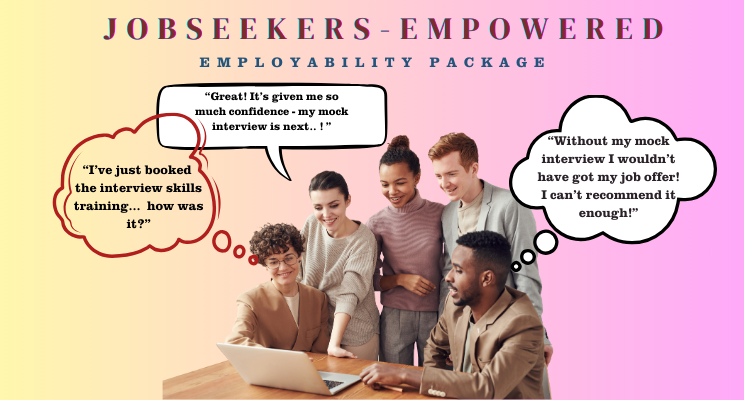
www.jobseekers-empowered.co.uk (Tailored charged plans): If you are seeking a dedicated bespoke service with human intervention, we offer an employability package to ensure you add authenticity to your CV; contextualise your work experiences and skills; provide interview preparation coaching and mock interviews; and provide personalised coaching and mentoring. Book a free consultation to find out more.
Identifying new careers with AI
AI assessment tools can help locate suitability for jobs, including those never considered before previously, such as stereotyped jobs to a particular group of people i.e.. gender-based roles. A suggested AI tool called Careerontrack.ai can explore new career paths and connect you with industry mentors. They offer free trials for assessments covering career exploration, skills assessment, personalised learning, industry insights and mentor matching. However, post the free trials you would need to sign up and pay for any further plans. For graduates, there is a free service provided by Bright Network called a Career Path Test to assess your suitability to a career that matches your skills and values.
Which jobs will be at risk by 2030?
Accountants and bookkeepers, cashiers, customer service representatives, receptionists, proof-readers and translators, security and military personnel, surgical assistants, courier services, and photographers.
What jobs will remain and be sought?
Engineers, teachers and educational professionals, hospitality and food preparation, animal care workers, sports and fitness occupations, lawyers and judges, graphic designers, editors, computer scientists and software developers, PR managers, event planners, marketing managers, coachers/mentors, writers and authors.
The future of AI technologies
AI is rapidly affecting most industries due to the speed of emerging technologies, resulting in companies seeking to implement and invest in AI integrations essential for their business. The benefits are automating time-consuming processes that are currently manual, reducing costs and gaining a competitive edge. AI services are costly so only larger companies can currently afford these; however, longer-term costs are expected to decrease over time with advancements in cloud computing, eliminating large upfront investment for smaller companies. The future focus will be regulation, looking at ethical standards and classifications on AI risk tiers.
On the global stage, a report from the World Economic Forum stated 85 billion jobs will be lost through AI but a projected 97 million new roles will be created in AI development, data science and human AI-collaboration.
In the UK, the labour government have committed to a £200 million investment into AI research which will innovate many sectors, including recruitment. It has been estimated that AI could create 7.2 million jobs in the UK by 2037, whilst also displacing 7 million jobs – overall resulting in an additional 200,000 jobs.
Artificial intelligence will reach human levels by around 2029. Follow that out further to, say, 2045, we will have multiplied the intelligence, the human biological machine intelligence of our civilization a billion-fold.
Comments